Author: Wribhu

  • Basics of Mobile Payments

    Understanding the basics of Mobile Payments required me to find answers to these questions.

    What is a mobile payment

    What are the formats/models of mobile payment 

    What is the infrastructure required for mobile payment

    Are mobile payments secure? What are the security measures adopted?


  • What the dog saw – Malcolm Gladwell

    what-the-dog-saw-Malcolm-GladwellWhen my cuz mentioned about this Gladwell book, my first reaction was why the funny title. It seems the title is inspired from Gladwell’s efforts to get inside the other party’s head. He talks about the ‘Dog Whisperer’ the guy with the magical effect on unruly dogs, and wonders how it would be to decode the magic by understanding what the dog saw in the ‘Dog Whisperer’.

    The book is actually a collection of stories Malcolm wrote when he was a staff writer at The New Yorker. Each one is backed by powerful research and has powerful stories that make for a very interesting case-study.

    Some of the interesting lessons I found in this amazing book:

    • While pitching remember who is the star. When a celebrity endorses a product, the star in that commercial or pitch is the celebrity. The Pitchman who made a million dollars in an hour selling a kitchen appliance on TV, made sure that the product was the star. Always.
    • Study who is using your product and how. Kids do not control what they get to eat. Hence they cherish Ketchup with most meals, because it helps them control some bit of what they eat. Heinz noted how kids reached out to Ketchup bottle more often than adults . One of their senior team was out studying consumer behavior and noted how the kid was told not to handle the bottle on her own. Heinz noted this and ensured that their bottle became the kid-friendly EZ Squirt bottle.
    • We have a strange way of processing probability. In a chapter around Nassim Taleb and his counter-intuitive trading strategy, Gladwell talks about a small social experiment done. A set of individuals were given two options – A: Get $100 or B: Throw a coin & if you win get $200. Most opted for option A. When the experiment was reversed, surprising results came in. Now people were told that they could choose from C: Pay $100 or throw a coin and pay $200. Most people now wanted to test their luck and take a chance at losing their money.
    • To sell pain killers, you need to understand the person in pain and not just the pain. A classic example given talks about how a company found that its pill was being used both by people suffering from head-aches and stomach-aches. It took an advertising firm to discover that the consumer was in completely different mindsets. A person suffering from stomach-ache tends to blame himself for overeating etc and hence considers himself to be the culprit. A head-ache patient on the other hand is more in the victim mindset. Even if the same tablet can help both, you need to understand what to say to them in each scenario.
    • Puzzles vs Mysteries. Malcolm talks about how we currently live in a more open world where there is an explosion of data and information. In most instances these days, it is not a challenge to get more information, but to figure out patterns and make sense of the maze of data. The former is referred to as a puzzle and the latter scenario as a Mystery. While this was written way back in 2007, I think Gladwell was talking about Big Data as we know it today.
    • Bell Curves are misleading. While I agree 100% with the abusive nature of Bell Curves in the corporate set-up, Malcom brings up a more relevant aspect of it in policy making. It seems that most social challenges have few outliers who take up most of the cost of the program e.g. few polluting cars if removed can bring down the pollution significantly. Hence the approach should not be to manage all cars and check them, but find the polluting ones (in a smart way) and addressing them. I think the key point he makes is that with a bell curve we assume that each car is contributing in some way to the problem, where as the problem is limited to just a small subset of population on the extreme end of the graph. So no point making a policy for the whole distribution.

    Its a great read with stories on the how the Birth-Control Pill evolved, how fight against Breast Cancer is a study in human evolution. You can buy it on Flipkart here

  • Mobile Payments Security – concerns, issues, threats, models and measures

    One of the biggest reason why cash has still reigned supreme for purchases is the percieved safety it brings. It limits the potential damage to the hard currency one is carrying in her wallet. For many late stage adopters of plastic payment systems, secuirty has been a concern. Same is happening right now for Mobile Payments.

    Why is security a concern in Mobile Payments?

    Any financial transaction involving out-flow of funds without over-the-counter transactions typically weighs heavily on consumer’s mind due to the risks involved. Mobile payments are no different.

    The security concerns are aggravated in case of mobile payments, because the ancillary infrastructure is something that the consumer uses for many other purposes. And in many instances the consumer has seen a part of this infrastructure break. E.g. consumers would have experienced first hand their mobile phones conking off, or heard of virus attacks which erased or corrupted the phone’s memory. In contrast for debit or credit cards, the consumers would have rarely heard or experienced wire-tapping or cloning first hand.

  • Why Financial Services Cos need Designers and fast !

    I just came back from depositing a cheque into a relative’s HDFC Bank account. I know, its a crime that I did not use the Online Money Transfer services, especially since I am a self proclaimed Digital guy working in the Financial Services sector.

    Anyways, I was filling in the deposit slip with details of the cheque and the beneficiary account details and suddenly there was this huge frustration in filling the same information twice.  HDFC Bank does not use a carbonated Deposit slip like Citibank India does. And it stuck me that once I have experienced the Citibank’s way of filling the information once, I refuse to be forced through the seemingly ill-designed process. I eventually did fill in the bank’s half of the deposit slip but just scribbled the bare essentials in my half of it.

    So it got me thinking, why is it that our banks and other Financial Services companies do not “design” with the customer-experience at the center. In today’s world when better designed products and services are beating-the-shit out of their established competitors, why are Banks and Insurance Firms so slow to react.

    The rise of well-designed products and services is not something which is purely outside of BFSI sector. Any payments industry person would tell you that Square is a serious threat to VISA and MasterCard in specific business segments. Square’s well designed product and application just removed a few major hurdles in the overall process.

    The Branch

    The branch is probably the single most important customer touchpoint.  You might argue otherwise that your call-center or the website gets more traffic and handles more transcations. But the reality is that its at your branch that a true face-to-face interaction happens and that too because the customer wanted it. The customer is so keen to do that transaction or resolve that query that she has taken the pains to walk to you.

    Have you been to a branch of a Public Sector bank? Chances are that the iron-grill was chained and you had to take care while entering the branch premise. Sounds familiar? What do you think a customer feels while entering such a premise? Is he in a mood to listen to someone telling him to buy an Insurance product or is he likely to just walk out of the branch as soon as his chosen transaction for the day is done?

    I recently went to a TCS powered Passport Seva Kendra (PSK) and boy did it feel like a whole different world. The premises were clean, air-conditioned, there was line and crowd control. A token system which ensured timely processing, a display announcing which desk you had to report to and the works. Compared to my first experience this was a complete contrast.

    While getting your branch to look like the Jabong ad  might be an easy task, what is needed is a design oriented approach towards all the aspects of the customer touch points. Do we expect the customer to wait on us, if yes, is there a waiting area. Are our clients senior citizens, if yes, what facilities do we have for them (say dedicated desks). Do we serve them just water or tea/coffee too? Is it a self-service kiosk or we have a kitchen hidden somewhere. This very simple question is something that many MNC companies have failed to understand in the Indian context. I have been to a few corporate reception areas, where there is no one to ask you for water, leave aside tea/coffee. If you serve Indian customers, you might have created a big wall right there. Its part of our culture and just because its a corporate set-up we cannot ignore it.

    Jabong-bank-ad

    Beyond the branch

    Opportunity to design better goes beyond just the branch or the physical world interactions. Here are a few others that are ripe for design-disruption:

    • Credit/Debit-Card chargeslips. I remember that a French company presented to us way back in 2004 about printing chargeslips with detachable coupons. In almost a decade the only variations one has seen is probably an ad on the reverse instead of the usual T&Cs. The key thing that any designer would probably do is ask why a customer is given a chrageslip in the first place. If this is to keep as a proof of transcation, then most of current thermal printers beat the whole purpose. The ink just fades away. Does the customer need it to file for expense claims and reimbursement? How does the customer store it? Does it stay in their wallets or does it go into some envelope or drawer. I don’t know the answers but I sure know that chargelsips in their current avatar just don’t cut it.
    • Websites. I remember reading the findings of a Kern report which states that almost all Life Insurance co’s websites had a poor overall user experience.

    “Most online insurance websites provided minimal details about the policy, mostly hidden in a PDF brochure, making it very difficult for the customers to find details. The customers had to spend time to search for information, which was distributed throughout the website, in the absence of any reasonable user flow.”

    • Even Mobile apps. A friend on my Facebook network posted this. Enough said.

    American Express App

  • Leadership Lessons from Making of India – Book by Ranbir Vohra

    making of India - Ranbir VohraIt was quite some time back that I read the book – Making of India – by Ranbir Vohra.  This was December 2006 and I had a habit of taking notes from any book that I read. Sometimes even movies. So what you read below are my interpretations of the historical narration of India’s journey of acquiring its national identity.

    Good Leadership involves Policy Making. More effective than individual action.

    For Political leadership, this has obvious relevance, but I would feel safe betting that this is true in a business context too. Imagine the kind of ripple-effects that the CEO can create, by clearly articulating effective rules and policies. This would include not only the core values that the organization wants to pursue but also how to conduct itself in the marketplace. How is performance measure, how are incentives decided, how do you gradually build the culture and the DNA of the organization. All of these could be better achieved by effective policy making esp in the context of a big organization.

    Learn to trust your team and delegate effectively.

    Delegation is a pretty obvious trait one would expect in a leader. Motivation to delegate might differ. Some leaders might be inspired to create free time to think, like Jeff Weiner(CEO Linkedin) does  whereas others might do it out of sheer laziness (which by the way is again a good virtue of a leader, if found alongside intelligence).

    Sometimes you need to lead a team of people you don’t trust or consider incompetent.

    Sometimes, with the bigger goal in sight, you might be forced to choose a path where you end up leading a team of people you don’t really trust. Or whom you consider grossly incompetent. And inspite of your drastic opinion if the party(or organization or team) enjoys the support of the people (or the market in case of an organization), it wouldn’t be wise to remove them as the first step once you assume charge of the new office. Create an able leadership that is recognised by making the machinery work and slowly remove them in a phased manner. While this might sound scheming to many, I saw this as a way to keep the bigger interests of the party at the center.

    To get your way through a tough negotiation- Create a diversion

    Sometimes when you are stuck in a tough negotiation situation, a serious distraction might help. Create a new clause and pretend that this is what matters most to you. But be careful to choose something that the other party would find almost impossible to concede. Now with this new clause coming in, the other party (hopefully) focuses energies there and might go easy on the original bone-of-contention.

    Need for Symbols. How do you inspire people?

    Gandhiji’s Dandi march is a great example of how you build support. Find something that many can relate to or find an activity that many can participate in. Symbols can similarly act as a strong rallying point for your team/supporters. Symbol doesn’t necessarily have to be a prop or a logo or an image. It could be a simple tradition – like wearing Khadi . Create traditions that can start to mean a lot to people involved over a period of time. And you might end up creating a legacy that generations can relate to.

    Also it is important to stay connected with your organization. Stay connected by talking to them regularly. Start by clearly articulating a dream, a vision, a reason to exist (for you, for your professional self, for the party or for the organization). And then keep re-iterating this vision. Make them believe in it as much as you do.

  • 9 challenges in digitizing the sales force

    Very few of us embrace change.Most of us would try our best to avoid any change in the status quo. Especially if it drastically impacts the way we work.

    Hence any initiative to convert an offline banking/insurance sales channel into a digitally-enabled online one, is sure to face a lot of resistance from the existing teams and one must be prepared to weather these strong head-winds. While there is no single solution which you could adopt, but a deeper understanding of what causes this overall resistance, would help you understand what needs to be done in your specific instance.


    sales-channel-digitization
    Source:Contractlogix.com

    Here’s my list of 9 challenges you might face in digitizing the sales channels at your bank/insurance company

    1. Sales force was not kept in the loop. Implementation was just thrust on them one fine day. Time and again we see that the lack of confidence-building measures lead to a clear mistrust in the new system and its capabilities. As the CIO or project owner you should start engaging with the end-users early on. Talk to the sales managers, their executives and articulate the clear value-add this would bring to their lives. Tell them how this system would make them more productive and help them grow in their art. Keep them posted about the progress of the implementation. If possible try and incorporate their feedback in the design/feature specs of the chosen solution. This would create local evangelists for your project and make your implementation so much smoother.
    2. Fear within the sales team, due to the sudden transparency. One of the key reasons, most enterprises wish to move their sales teams onto a digital platform is to bring transparency in the sales engine. There is an accurate real-time understanding of the key business metrics and hence a realistic estimate of the business pipeline. While this might be great for the Head Office staff, this is a matter of great fear for the sales executives and junior sales managers. They know that such a system would mean that anyone can drill down deep into a specific case and verify the details. Or the fact that the country head can also track each person in the sales machinery. This can be really intimidating for a junior sales resource. Imagine a magician’s trick being laid threadbare by a scientist – surely the magician would feel kind of naked. The way to address this fear is to ensure that the senior management refrains from micro-managing the sales team in the early days of the implementation. They should control the urge to dig-out a specific case, jump all hierarchies and talk directly to the sales manager. If your organization is not already used to a hands-on approach by the senior management, such jumping-of-hierarchies would spell disaster.
    3. Information Overkill. One of the advantages of any digital solution is the fact that it can store a whole wealth of data on the prospect, customer, channel and hopefully churn out beautiful reports in the process. If one gets carried away with such beautiful-reports-promise, the system might tend towards an information overkill.And the sales staff would be wasting time collecting “un-necessary” information when they should be out there talking to your prospects. Hence try and look at the system implementation as a phased journey. Get the basic feature spec out, build traction and revisit for further enhancements. It might be a good idea to read the MVP (Minimum Viable Product) approach now being promoted by most Silicon Valley Start-ups.
    4.  Non-existent or inefficient mobile interface. This is really relevant for enterprises where the sales happen face-to-face rather than on the phone etc. If your sales team is expected to be out in the field, your solution should go along with them. Many enterprises fail to imagine and develop a mobile solution and then focus on work-arounds. There are companies that expect their sales teams to call up a central number after each visit and update the details. In some others, the agent first notes the feedback on paper and is then expected to come to an e-enabled site (branch or café) and update the system online. In today’s world with such a high smartphone and 3G penetration, a mobile-first-interface would show a clear value to the sales teams.
    5.  Cluttered Design or too many screens. Unlike the glamorous world of consumer solutions, enterprise solutions have not been blessed with the talent of awesome designers. I personally feel this is a big big drawback because end of the day, the enterprise solution user is the same person. He would react the same way to a better design. If he has a great intuitive interface on his Gmail, Dropbox and Facebook, why not on his Leads Management System (LMS).
    6. Complicated Incentives. Increased transparency of the sales engine, suddenly throws up a bunch of metrics that the business managers love to track. While the incentives are simple to calculate and manage in the offline world, a LMS implementation usually comes with a highly complicated incentive plan. Most sales agents fail to have confidence in a new incentive system if there is no baseline. DO NOT coincide your system go-live with an incentive model change. Better idea would be to track the metrics for a while, show the agents how they are anyways performing on these metrics and then gradually build these metrics into the incentive system. Such an approach would mean that the sales team can “calculate” their possible incentives on Day 0 and be motivated to stretch their performance.
    7. Lack of helpful features. This usually stems from the lack of an agent-centric design (which is discussed separately in pt 8). Build features that really help them sell better, help them save time (e.g. tablet based insurance quotes means zero error in policy submission and hence no rework).
    8. Lack of agent-centric design. Enterprise solutions usually fail to deliver on their promises because of their inherent design (or architecture). Many an enterprise CRM solutions are not designed with the customer at the center. Similarly if our sales systems are not designed by keeping the agent at the core, it surely would see a lot of resistance and would fail to deliver. A good design where agents were involved from a very early stage, would take care of most of the issues mentioned above.
    9. System Roll-out plan
      • Lack of training before and during roll-out. Even if you are working under serious budget constraints, find a way to train the end-users. Build a knowledge repository, run a small help-desk for them to call/reach for any immediate help.
      • Find and promote early adopters. Even better find evangelists who carry a collective sense of ownership in the system and its promise. This needs to be done at all levels. I remember when I was rolling a LMS for the bank that I was working for, I had to convince the business head about the need for such a solution. All the usual advantages of a scientific way to run the sales channel couldn’t cut any ice. I had to finally show him the maths around system’s ability to uniquely pull-out non-contactable cases from his tele-calling units and hence a smaller base to work on for subsequent months. This simple feature was powerful enough (with enough cost savings on back of lower manpower requirement) for him to get excited and seek his business as the first one to cut-over.
      • Version 2.0. Do you hear what your users are saying? Are you evaluating the impact for the new features or changes they are asking? How soon can you give them a version 2? Its not so much about the number of days they end up using the version 1. It’s more about how soon, they start believing that this is their system and the company hears what they have to say.
      • Study how your users are actually using the system. Try and shadow some of the end users to see if they come up with their own work-around, own ways of using a feature for something that it wasn’t really meant for. What are they not using at all. Why? This is usually a great surprise and teaches most system designers a whole lot of stuff they had never imagined or seen before. Try and document these observations. Analyze and see if they can help you in a more acceptable version 2.0.

    In summary, some level of resistance is inevitable once you decide to digitize your sales team. But how you design your solution, how you engage with the end-users and how the enterprise uses in the early days, can decide if this will be a success or not.

  • The Code Book by Simon Singh

    the-code-book-simon-singhThe Code Book – is a short history of mankind’s journey to be able to transmit messages secretly. Its a very well researched compilation of what were the pre-cursors to the modern technology field that we call as encryptology.

    I found some of the examples really interesting:

    • Amongst the first ways to send coded messages via a messenger through non-friendly territory was the means of writing the message on the messenger’s scalp. The king would choose a messenger,shave the guys head, write a message with a special ink and wait for the hair to grow back again. The messenger would then pass through the enemy territory and even if searched, no one would probably guess that the message is on the scalp. The messenger would again get shaved at the other king’s court so that the recipient king could read the message. Very intuitive but I guess once the word spread, most travellers would have been shaved as part of their search
    • The Roman period saw a very advanced cryptology technique – simple to code and very tough to decode. The Romans would have a special septre on which a narrow strip would be rolled and the message would be written. When the strip is unwound and read vertically, its completely gibberish. The only way to read this was to roll the strip back again on a cylinder of the same diameter. This was taken a step further and the woodden staff used was not a simple cylinder but a tapering one, which added to the complexity of someone trying to break the code using brute force.

    Simon Singh highlights that the history of genuine code-breaking has been based on a simple premise – find patterns in the code and break the problem into smaller parts.

    On the other hand, to make a good code, one should

    • Avoid putting a condition as it reduces the number of possibilities
    • Aspire for a multi-stage cipher where the subsequent stages lose the path from the previous ones
  • Lack of pride – worse problem than corruption

    Aam Admi Party and its parent movement – India Against Corruption – started a fight against corruption- probably the greatest evil which is eroding our country in all possible manner. I have always felt that whether we like the women/men/kids leading this movement or not, whether we like their methods or not, we should stand by them. Coz they give us hope, hope that things would change for better.

    For the last few weeks, I have come to believe that there is a bigger evil plaguing us. Something which is worse than corruption – Loss of Pride.

    As a nation, we seem to have lost our collective pride. Theres a whole bunch of couplets which go like this – “Sau mein ninyanve beimaan, mera bharaat mahaan !” . Translated – 99 out of 100 are corrupt, but still my India is great (Its pure sarcasm, if you missed it!)

    Let me share with you, as to what triggered this thought in my head?

    For the last 7-8 years that I have been in Delhi, I have noticed that the same stretches of roads are flooded during the monsoons year on year. I am also pretty sure that the relevant officials at MCD or PWD departments are aware of this. I can also buy that there is rampant corruption in the relevant department which might be the root cause of this. But what I am surprised with is that how come no Engineer felt repulsed by this.

    Why is no one saying,

    Its a shame for me, for our team or for our department that this is happening. Lemme see what I can do.

    From whatever little I know of how government departments work, one guy could have made a huge impact, if he/she felt a serious dent to their pride with this water logging.

    Why is it that we are not ashamed about our failure to deliver on our promises? Our ministers don.t resign these days even when they are faced with serious charges.

    There was a time, when the Prime Minister asked the country to skip one meal to raise funds for the army, and the nation followed gladly. Imagine what a sense of pride each such contributing household would have felt.

    I remember reading the news about the Japanese pensioners asking the government to send them to the Fukushima nuclear plant, so that the young are not exposed to radiation. Wow !

    If you were a young Jap workman assigned to this project, how would you react. If you were the parent for such a workman or if you were the son or daughter of someone who just volunteered, wont you be overrun by a flood of emotions. I am sure, such a strong surge of emotion is sufficient to walk away from temptations that corruption might bring forth.

    Japanese Nuclear TragedyLakshya movie shows Amitabh telling his regiment that their predecessors have created a rich and proud history, with numerous sacrifices. And that they (the regiment) have never failed to deliver on any task assigned to them. Stop and think about it.

    If you are inducted into such a unit, wont you be charged to go beyond your own capabilities and ensure that you keep the flag flying high? I know I would.

    Or the scene where he reminds his men, that the Indian Army has a certain code of honour, and will pay due respect to the dead bodies of its enemy soldiers, even when they fail to extend such honor to ours.

    Lakshya Movie

    Another movie, maybe it was The Burning Train – shows a sardarji with his wife and a young son. The wife is crying as they face a sure death and the sardarji says “Oye tu Sikhni hoke ro rahi hai”.  I saw this scene while flicking channels and was zapped ! They are facing death and the Sardarji is surprised that the wife – a Sikh woman – is crying.

    I dont know how to instill a sense of pride in someone. I am sure building a sense of collective pride is even more difficult. But what I do know, is that this can be taught in individual homes and class-rooms. And it is something very powerful, something which can help fight the temptations of corruption, help fight against the worst of odds.

  • Could “Gods” be aliens

    Chariots of the GodsI had heard a lot about Chariots of the Gods and finally managed to read it, inspite of the bad print. The whole book is based on one premise – Is there a possibility that the beings we refer to as gods and who have been talked about in various mythologies, be in fact aliens – superior intelligence-beings from other parts of our universe.

    While this may sound slightly outrageous and maybe even funny on the first instance, believe you me, the book builds a very compelling case. If you are the curious kinds, you would love it and I can bet, a lot of chapters would trigger searches on Google :-).

    I found some of the facts in Chariots of the Gods – very interesting:

    • Most mythologies seem to have a common thread that the “Gods” descended from the sky. Many even say they had flying chariots  or had wings.
    • Some civilizations managed to make sudden progress or achievements that were not in sync with the skills or the developed knowledge of the days.E.g.
      • The Egyptian pyramids (esp that of Cheops) have been built with such accuracy on its slopes, that even modern day architects might have a tough time competing with. Apparently the side slopes are 100 times better than what the naked eye can notice.
      • How the Pyramids were built has been a mystery and the most promising theory has been that the blocks were rolled on logs of wood and heaved by an army of slaves. Erich puts this theory to test by asking as to where the wood came from. How could the narrow-fertile part of the Nile delta feed this huge army?
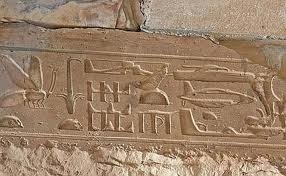
      • A heiroglyphic tablet found in another pyramid has this interesting set of diagrams, one of which is like the modern day helicopter.helicopter shown in Egyptian Pyramid Tablet
      • Mayans had an awesome calendar that was not only super accurate but was used to design their pyramids with the twin headed serpents – the ones they suddenly abandoned.
      • Same with the Eastern Island structures. Its impossible that the folks of that era could have lifted the single blocks which form the hats (its apparently from a different quarry as the remaining body)
    • Most mythologies have stories about a hero-of-a-man undertaking a journey to meet the gods and in quite a few cases coming back with really sophisticated weapons.(remember how Arjuna journeyed and got special powers before the big battle. He apparently met Indra, flew with him in his chariot etc etc).
    • Apparently there are pyramids in Bosnia also (not mentioned in his book) which are subject to an ongoing debate whether they were man-made or just re-shaped at the periphery by man. Then theres the Pyramid of the Sun in Mexico, again an archeological feat.
    • There are diagrams and carvings from civilizations of the past, that clearly show what looks like a space-suit or a rocket-traveller.
    • And many more ……

    Fully recommended if you think there is such a remote possibility that what or who we refer to as Gods, could have been visitors from outer space.

  • The curious case of single order and multiple delivery consignments @ Flipkart

    This just happened to me again in a short span of time. I ordered 4/5 books from Flipkart and the ordered was split into multiple consignments and the two consignments were delivered within one day of each other.

    Initially I thought this was because the books might have been shipped from different warehouses or even merchant-locations. And maybe the second consignment’s availability and delivery- date wasn’t estimated before the first gets shipped out. But then again, both were delivered within 24 hrs of each other.

    Flipkart Deliveries

    Interestingly, since Flipkart does its own delivery, the same guy comes to deliver all Flikpart stuff at my place. He knows me pretty well by now and I asked him if why the same order was being split into multiple consignments. Even he was finding it funny that he delivers two days in a row to my house. He only knew that he has a certain area allocated to him and all his delivery packets come from one holding warehouse in NCR.

    Maybe thats where this is coming from. That Flipkart has a beat allocated to each guy, and the delivery guy has to work that beat each day. Hence it doesnt make much of a difference in splitting the delivery into two parts – he would be around in the neighborhood anyways.

    Also, I figured out that many of these deliveries were COD and maybe this was a way to put a cap on how much cash the delivery guy handles. Or maybe the risk of not shipping a big consignment to someone who turns it away or acts funny.

    But I still feel, they might find an opporutnity to further trim down their logistics cost and maybe even enhance the customer experience if they could find a way to re-aggregate consignments at the last-mile. Or will that put pressure on the mini-warehouse ? What do you think?

  • Inflection point in Global mobile sales – Q2 2013

    The latest Gartner Mobile sales reports are clearly saying one thing – the 2nd quarter of 2013 has been the inflection point in Global Mobile sales.

    Smartphone sales data

    1. Feature phone sales were lower than Smart phone sales for the first time ever. This is big, as it is a sure sign of how mobile usage trends would look like. Mobile operators across the developing world must be cheering this report as it is a strong promise to them that the data-usage and hence non-voice revenues might increase. The gadget is no longer the bottleneck.
    2. Micorsoft Windows overtook Blackberry for the first time to be 3rd biggest Operating Source.
    3. Android is now almost 80% of new shipments (up from 64% last year) where as Symbian is down to o.3% from almost 6% last year. Symbian was what Nokia’s feature phones ran on.
    4. Lenovo is now the 4th largest Smartphone supplier and the 7th largest across all categories of mobiles. Interestingly, almost 95% of these sales are domestic sales within China. If Lenovo can crack the international markets, they would be a serious player to reckon.
    5. As expected Samsung took the biggest pie – 25% of overall mobile market and 32% of the smarphone market.
    6. While Apple saw an increase in its number of units shipped, it saw a serious drop in its average sales price. Mainly due to the heavy sales of its now-cheaper iPhone4 especially in markets like India. Many are saying that this is yet another reason why Apple might want to consider a low-price-iPhone.
  • HDFC Life’s Campaign to protect you from the rains

    A colleague recounted an amazing experience she had at the Delhi Airport a few days back. She had just flown in and was waiting for her car.

    There is this small stretch at the Delhi airport that you need to cross from the covered porch of the terminal, to the waiting-car-lanes.  While the stretch is small, its easy to get soaked if its raining.

    There were young boys holding huge family-umbrellas trying to help people save themselves from the rains. The umbrellas were branded with HDFC Life logos and these enthusiastic boys were helping passengers reach their cabs/cars without getting drenched. And while they walked with you to your waiting car, they would very politely hand over a small HDFC Life card (images attached) which promotes their Click2Protect – Online Term Plans.

    Click2Protect

    I was so impressed by the way HDFC Life managed this.Could see so many reasons for them to be proud about this campaign:

    1. Its a very relevant offline activity. Most of us do not carry umbrellas and do get drenched a little bit if its raining.
    2. Insurance industry has been using the umbrella to highlight protection for years now. I can remember seeing way too many things under that umbrella – from house to family. But finally someone has made a meaningful and relevant use of the most recognized prop of the Insurance Sector.
    3. There is no hard-sell and the card is actually very humble in its tone and starts the conversation very meaningfully

      Thank You for letting us protect you

    4. Its probably one of the best Offline-to-Online campaigns that I have seen so far. They have chosen a simple product category to share – Term Plans. A product category that has been witnessing the biggest rush for customer-initiated-online-purchases.
  • Bell Curve and the Appraisal Process

    Imagine that a football team needs a manager/coach, someone who can motivate the players and help them deliver much more than they ever imagined they could. Now imagine that a seasoned HR manager somehow lands this job, someone who has been a big fan of bell curves and the other smarts we have grown so used to while managing teams at workplace.

    Would this new manager/coach go about tracking each player as per their performance on a balanced scorecard (hell if Moneyball is to be believed, he could optimize the success by handpicking the players with the right kind of stats)?

    Would he go to the players at the end of the season and say, well you managed the mid-field really well but given that the center-forward and the goal-keeper had an amazing season, I am afraid I would not be able to mark you in the top category? You know, I have a bell curve to fit.

    Would he still use a bell curve when the team comes up with a record winning streak. Would he still internally want to build a bell curve for the individual performances or would he be happy to see that maybe these individuals are now coming together as a team.

    Football team managementIn a team where every guy has a different role to play, do you really want to track performances and benchmark it against the best in the field (across all other teams) or would you want to benchmark them against different players within the same team?

    Also can a team with top players in their own leagues be the most successful team? Not really. Time and again we have seen dream-teams fail, not because the players were not giving their A game, but because all the A games still added up to a B or even C somehow.

    Corporate performance appraisal processes incorporate this by giving a certain weightage to the team or division or the company’s performance. This is expected to factor in company’s performance and temper the ratings accordingly. But does it motivate the employees to deliver as a cohesive team?

    I do see the difference between a football team and a corporate and maybe the smaller size of the football team helps and you need a “process” for a corporate so that the whims and fancies and biases of the individuals are minimized when it comes to rewards. Its easier for managers and employees alike to aspire for a “score” – a number on the rating grid that helps them know how they have performed. Its easier to compare performances within the team basis the score. Easier to justify the quantum of raise that each one gets.

    But we miss one simple point.

    There are times when a lot of high performers would be concentrated in one team. Say a rockstar senior in the company is asked to launch a new business and he is allowed to hand-pick his team. If he gets some of the other rockstars and they have an awesome run, do you imagine him telling his team that he needs to fit in a bell curve?

  • M PESA story

    What are the things M PESA did right?
    • Clean and focused campaign – “Send Money Home” – focused only on national remittances – something that was done in abundance
    • Transaction fees were the lowest for any mode of money transfer
    • Fees clearly communicated with slabs/displays at agents
    • Differential pricing for customers paying to other customers vs non-customers. This brought in viral effects and drove further registrations
    • Security was the main plank as money transfer was not all that safe
    • Realized that trust resides in timely delivery of SMS receipt. Initial outages or delays created a lot of complaints. mPesa team upgraded the SMSC servers and the menu also
    • Low hurdles to join/sign-up. Any ID proof worked and there wasn’t much KYC done
    • Availability of agents was high. Uncomporable distribution reach.
    • Agents were handpicked, shortlisted after a comprehensive evaluation and then trained sufficiently
    • Agent level liquidity/cash management
  • Mobile Money Facts and Figures

    Opportunity Scale

    • 1.8 billion people globally have mobile phones but no bank acocunts (World Bank)


    Success Stories/Adoption Figures

    • 20% of Kenya’s GDP moves on mPESA (2013)
    • 20 nations in the world where more than 10% of the population has used mobile money in the past year. 15 of those countries are in Africa (Global Financial Inclusion Database). Quoted in EY Mobile Money Report
    • Square’s Growth in terms of payments processed : 2012 – $10 billion a year, 2011 – $2 billion a year
  • CEOs role as friction buster

    Not so long ago, a Private Equity guy told me that I was trying to do too many things as the CEO. Initially I thought he meant that I should hire more people and let them manage the daily operations. While that was there, but what he went on to mention could probably be summarized as – CEOs should play the role of friction busters.

    CEOs as friction busterAt that point of time, I was not really convinced as I felt it was necessary for me to be hands-on and keep my ears to the ground. Given that these were early days of the venture, there was so much to learn, so much to tweak, so many experiments to run.

    But over the years, I have come to see the value of a CEOs role as friction buster, especially for a growth stage venture or even a start-up where the product/offering validation is done and the revenues are coming in.

    So what does a CEO do as Friction Buster:

    In any organization’s journey, there are two types of roadblocks  – external and internal.

    External could be the market conditions like consumer preferences, competitors product or pricing or even regulatory changes. That apart there are hurdles that one finds within the team. These could pop-up in the form of a poor-culture, lack of internal processes, insecurity within the team and so on.

    The CEO should be spending a good amount of time removing these internal hurdles to growth – ensuring a great culture that thrives on collaboration, innovation. Where team members feel secure and feel and act with a certain sense of ownership. These would typically span not just the Human Resource function, but would also encompass the technology and operations set-up.

    Why is it important?

    • Keeps your team happy – If the CEO is able to hire rockstars and then help them be better at what they do – it would not only show immediately in the financials, but would help build a happy team.
    • Do it early on – A venture is like a car which is planning to pick up speed. If there are fine-tunings to be done, its best done when you are still at a low gear.
    • CEO is the best guy for the job – He/She has a complete context and would be able to prioritize the multiple internal opportunities.
    • Its not just the sales numbers – Too often we are trapped in the sales oriented metrics and keep focusing our energies on getting a bigger share of the market at lower costs. But too often, the constraints lie internally – in who we hire, how they work, how we fail to empower them or how we fail to build a solid culture.
  • Uttarakhand Flood Relief – What we can do

    I have been asking around to identify possible areas where we can chip in to help with the Uttarakhad Relief work. Adding the options I have found so far, here so that those who wish to support can find it easier to do so.

    List of Medicines needed for UKhand (source Goonj website)

    List of other materials needed (source HIMVKAS)

    • Ropes (strong) to make/support temporary routes
    • Food stock – Rice, wheat, pulses,oil, sugar, tea
    • Cholrine tablets, Glucose, face mask, first aid kits
    • Tents & blankets
    • Cooking utensils & fuel
    • Solar lights/torches/batteries

    Where can you send the materials:

    • Goonj has pick up centers
    • Medicines can be sent to Doctors4u also who are running camps in the affected areas
    • For HIMVKAS the address is  Himalayan Jan Kalyan Avam Bal Vikas Samiti , Village & post Tilwari, Block Sahaspur, Dehradun – 248197 | Email:himbkas@gmail.com | Santosh Passi – 9760178654

    Updates from NGOs:

    • Post the search & rescue operations which have helped rescue a lot of pilgrims, the NGOs feel that a lot of work would need to focus on getting the locals back on their feet
    • Currently access was a hurdle due to continous rains and even basic damage assessment is not through
    • Some NGOs have started reaching out to the specific regions they work in, to identify the exact damage, build reports for a 18-24 months development/re-hab program. These reports would also help these specific individual communities to reach out to goverment and other sponsors for fund-raising.
    • Tent colonies would need to be built to weather the monsoon months.Uttarakhand Relief Work
  • Youth and Indian Politics

    On a recent flight I found myself sitting next to the NSUI General Secretary – a smart young guy from Jharkhand who has not only managed to rise through the ranks of the Youth/Student wing of Congress, but more importantly, has done so inspite of a non-political family background.

    Indian PoliticsI did my best to poke him on the issues which I felt would put any Congress supporter on backfoot – the corruption charges, the pathetic handling or Lok Pal Bill, the fact that party follows a family-leadership etc. To his credit, he tried to defend their stand on Lok Pal, said that the corrupt netas come from a corrupt society and it seems he genuinely believes that “Rahulji” is a true visionary.

    I could not agree with most of those responses, but when we started talking about what he and his comrades do on a regular basis, the real story started coming out.

    He talked about how RTI camps were being held in universities by NSUI workers – forcing the management to share the expense budgets, disclosing what was bought, from whom etc. And apparently it goes beyond just the treasurer’s role into other areas of the university functioning. I really loved his metric for tracking how well students would welcome such camps. Apparently flyers distributed in campuses are dropped in a few seconds and the ground is left littered with them. His smart way to assessing the interest was to see if flyers were carried by the students or dropped in campus grounds.

    I also enquired about how his party uses the cutting edge digital tools & platforms.  After the usual emailing lists etc, he referred to how they had created a Facebook page wherein anyone can upload a video indicating their complaint about say a broken road, overflowing sewers etc and the local NSUI members would help the citizens reach out to the right authorities and close the issue.

    I stepped out of the flight feeling happy that smart young folks are choosing to join politics and bringing in their fresh ideas and high energy. I just hope that they do not compromise on their ethics, and that they keep the society and citizens at the core of what they do, rather than just the party and its chosen set of leader(s).

    It might be tough for youth leaders like him, to grow in a political system where leaders never seem to retire.  Advani resigns at an age of 85 years and the party still wants him to hold active roles. Shouldn’t he be the chief mentor or something?

    Why don’t political parties decide on an age and have that as a mandatory retirement age?

    Why don’t our leaders mentor the next lot in a more formal way? Something that allows the young leaders to not only handle growing responsibilities but also learn directly from the senior members.

    Why don’t we have a report card of sorts for all candidates from each constituency? So that come election day, citizens can know the individual and vote for his/her work rather than for a party.