Category: Digital

Digital is creating more data than ever before – data that is being to deliver better experiences, better products and much more.

  • Embrace APIs – Digital Banking Toolkit

    Digital is the latest buzzword in banking. Not only are the bank boardrooms echoing with digital keywords, its what seems to be driving the pitches at most IT and Management Consulting firms.

    And rightly so !

    When the data tells us that 9% of the population already uses Mobile Banking, we know that Digital Banking Revolution is already upon us.

    India Internet Statistics
    Source: We are Social

    In the last article, I mentioned, how the Digital Banking Journey will be different for each bank and why it might be a good idea for the banks to play to their strengths.

    Equally important is to acknowledge and understand, that partnerships will be essential in this journey.

    And what enables partnerships to work (apart from a culture and mindset) is a technology architecture that is geared towards APIs.

    APIs are like Legos – you own some, some you borrow – but put together you make something exciting.

    While the consumer technology companies understand this, banks have traditionally been slow to embrace deep connects into their systems. The risk is too high ! After all banks have been trusted with the consumers money and data.

    But to stay viable, banks will need to embrace partnerships, learn to publish and consume APIs, while still not compromising the customer promise.


  • Digital India – its already here

    Today’s the launch of the Digital India initiative and quite a coincidence that I had an experience which makes me believe that Digital India is already here.

    Digital India

    Here’s what happened.

    I was in Mumbai and called for an Uber. I started talking to the cabbie to understand the target market for a specific use case for mTuzo . We are pitching to banks that with mTuzo we can help move their debit card customer from an ATM only to ATM + POS relationship.

    So I asked him which bank account he gets his Uber payments in – it was a SBI account and it was his choice. Uber gives him complete freedom to choose the banking partner.

    Next I asked him if he had a debit card for that account . Turned out he did.

    I asked him if he’s been using that card at ATM or for shopping also. As expected he had been using it only for cash withdrawals.

    Probing further I asked him what if he got 15-20% discount if he shopped using his debit card, would he consider switching from cash to card. And his response just stumped me.

    He said he’s already used his card for online purchases at SnapDeal. He did his first purchase using COD (cash on delivery) but once he was sure that they delivered just fine, his next transaction was through his debit card,

    Let me repeat that – a 30 something male who has been driving a cab in Mumbai for last 10 years, is only schooled till class 10th, who uses his debit card only for cash withdrawal, has used it online at SnapDeal.

    And what really really shocked me was his first purchase on SnapDeal. I can bet you will never be able to guess it.


    Take a few guesses…..


    …….

    He bought a selfie stick for Rs 300 (after a 66% discount). A selfie stick !!!!

    I rest my case, Digital India is here.

    Maybe we need a Digital Bharat initiative.


  • Mood as the context for marketing

    Something very interesting happened while I was using the Linkedin App on my mobile. I liked an article and pop came the message from Linkedin checking if I would want to share my love of the Linkedin App itself.

    The timing of this “Rate us on PlayStore” screen intrigued me.

    mood based marketingDo folks over at Linkedin believe that if I have read a lengthy article and liked it, I am in a good mood?

    If you ask me, may be I am. Atleast for sometime.

    And since that mood is caused by the content that was delivered on the Linkedin App, Now might be the best time for ask for a rating. I would rate them much higher.

    Maybe they didn’t do this on purpose and this was just a coincidence.

    But it still piqued my interest in “Mood as a potential context for marketing“.

    Did a quick Google and found that both Apple & Microsoft have applied for patents long ago on Mood based ad targeting. If this is at play, its surely super exciting stuff.

    Why?

    For one, mood is a very strong context. I remember once being told that the reason behind gorgeous women in skimpy clothes selling electrical switches was to get the predominantly-male-customer distracted and lower the apprehension about the product itself. If that’s been working for ages, surely a more trackable and insight driven model will be more successful.

    Also, this might help “push” marketing be more effective. Google driven pull marketing works predominantly on context – what is the customer looking for actively right now. Imagine products and services being thrown just at the right moment. Feeling all mushy thinking about your partner, and pop comes the mention of a romantic cruise. Imagine how hard would it be to not buy it then n there.

  • Play to your strengths – Digital Banking Toolkit

    Nadal is the king of clay. Given a choice of surface, I guess he would choose clay 9 out of 10.

    We all get it – one should play to one’s own strength. Its obvious in sports, but most of us fail to apply the same rule(s) in business.

    keep-calm-and-play-to-your-strengths

    As most banks embrace digital, this is one rule we should not forget.

    Look at the bigger PSU banks in India – it’s fair to assume that they have a big list of areas to focus on when it comes to going digital:

    • Channel migration of customers onto internet banking and mobile banking
    • Higher activation and spends on their credit cards
    • Straight Through X-sell campaigns
    • Improving the customer on-boarding experience
    • Reducing TAT for customer transactions and queries
    • …..and so on

    It sure can be overwhelming to look at such a big list. One might also be tempted to look at the success stories of the likes of ICICI Bank, Citibank or HDFC Bank and try to replicate their strategies.

    Will that work? Chances are it won’t !

    Why? Because those banks are different. Different in terms of their customer profiles, their capabilities and their partner eco-systems.

    When I look at the RBI’s data on ATMs, POS, Credit and Debit cards for Nov 2014 – its clear to me that for PSU banks, ATM presents a unique opportunity.

    Digital experience starts from a conversation, an interaction or a transaction – and for PSU banks these are happening in plenty on their debit card portfolio at the ATMs.

    SBI has 23.6K onsite and 22K offsite ATMs.And they had 2.4 crore ATM transactions !

    Their digital strategy should have a clear ATM story:

    • What opportunity does the ATM transaction present ? E.g. the bank knows where the customer is at that point of time. Using solutions like mTuzo they can share Offers-near-ATM and migrate customers from ATM to ATM+POS.
    • Citibank has just launched Funds Transfer functionality through ATMs. Or one could do mobile recharges.
    • PSU banks do not have an aggressive sales culture. This could be used to their advantage at the ATM, where its not a warm body pushing a product but maybe the thank-you screen which is “suggesting” a product basis past behavior of the customer.

    Hence, for any bank embarking on a digital journey, its imperative to ask – What is our strength?

    And align the roadmap to play to these strengths!

  • Why is Financial Inclusion important?

    Financial Inclusion is a common theme across multiple initiatives both by governments and private sectors across economies. Especially in the developing world, it would be safe to say that Financial Inclusion must be in the top 5 priorities of the respective governments.

    But why exactly is Financial Inclusion important ?


    Financial Inclusion takes an economy towards more equal opportunities

    Financial access is a key component towards providing equal opportunities and equal access for growth for various segments of the society. Just like education, nutrition and healthcare access are critical in driving growth of a population, so is access to finance and payment instruments. The Better Than Cash Alliance (Bill & Mellinda Gates Foundation) says in its 2014 report for the Australian Presidency

    Studies show that broader access to and participation in the financial system can reduce income inequality, boost job creation, accelerate consumption, increase investments in human capital, and directly help poor people manage risk and absorb financial shocks

    And why exactly do we need to work on removing inequality?  As Christine Lagarde (MD, IMF) said in her  June 26, 2014 speech at Mexico, the need for removing inequality goes beyond moral principles. It is a key ingredient for sustainable growth.

    Inequality is not just a moral issue—it is a macroeconomic issue. Our research tells us that countries with higher inequality tend to have lower and less durable growth. Inequality chokes the prospects for individuals to realize their full potential and contribute to society. Whether it is through personal experience or empirical evidence, one thing is clear—growth has to be more inclusive, and for this finance has to be more inclusive

    Financial Access can increase investments

    Whether it is individuals or small/medium firms, access to finance, builds the environment and comfort for savings and investments. This could be because of multiple factors:

    • Access to credit
    • Access to easy, safe, reliable means of savings and investments
    • Triggers and reinforcements (social, system-driven) that induce a culture of saving and/or risk-taking, investing etc

    Financial Access provides security/insurance

    The impact of negative scenarios is significantly high for those who have no financial security or insurance. The ability of an individual or a community to bounce-back from a calamity is directly related to the access of funds made available during such times of need. Insurance has the other advantage of providing mental peace and a mindset where the poor are not constantly worried about basic sustenance.

  • Digital success needs a matured partnership mindset

    I believe that smart matured digital players will need to develop deep  partnerships.

    Let me explain why.

    With the growing consumption of digital media, there is considerable noise that a consumer is now exposed to. This would mean that the brands have a fast shrinking window of opportunity where they have their prospects attention.

    Most brands do understand this and hence have started investing heavily in better designs and more meaningful content.

    But when it comes to acquisitions, it seems that this underlying assumption is usually forgotten. Maybe the acquisition teams are overwhelmed by the amount of digital data they are expected to digest and optimize for. In order to increase the leads volumes, most brands usually explore new partners who have possibly captive audiences.

    In many cases these captive audiences are merely email id lists/bases that the partner has sourced not even built. And this might be the root-cause of my recent bad experience with a MNC Bank in India.

    I have been using a premium variant of this bank’s Credit Card very regularly for the last 8-10 years. I have my email registered with the bank’s card team where I regularly receive official communication from the bank.

    Interestingly I received am email for a gold card from the same bank on the same email id. This wasn’t a proposal to downgrade the plastic, but an email to take up a new card from the bank. I was confused. So I checked the email headers and discovered that this was sent by some partner of the bank who had my email id on its base.

    The bank didn’t scrub the partner’s base for emails already registered by existing customers. I can understand why the bank would not want to scrub and give back a base to the partner. Because then the partner could do a delta check and figure out which email ids are registered with the bank.

    Nevertheless the bottom line is that the customer experience was significantly compromised.

    So what could the bank do? What should other brands do?

    Partnerships in Digital WorldI feel they need to pick & choose partners carefully and then deeply integrate with them. They should in fact look at sending emailers from their own servers so that scrubbing is done real time and the partner just gets a report of how many emails were shortlisted for the blast rather than a list of which ones were shortlisted or rejected.

    Even if the partner is just worth the customer base it holds, banks would need to step up and control the subsequent stages of the lead generation process. On personalized platforms like emails, its customers can not be treated like New To Bank (NTB) applicants.

    In today’s world, we talk about data quality and data velocity. Maturity in both these aspects is possible only through an eco-system mindset and not in the current vendor-client approach.

    It would definitely add to the cost of acquisitions. And there might be other better, cleaner solutions but the current process just does not cut it.

  • Why mobile payments must arrive soon

    I try to go walking on most weekdays. And I prefer to do so light – carry just the minimal stuff.

    On my way out for a walk yesterday, I stopped by to take some cash along with me – just in case.

    And this got me thinking, with my smartphone (& earphones) I do not need so many other things.

    I know the time(so that I am in time for that movie), can listen to music while I walk, I can track my work emails (allows me to stay away from my laptop) , I know I can be reached anytime if the need arises(through calls, SMS, messengers etc).

    I can track my workout (and its just amazing what all some of the fitness apps can do), click high resolution photos while I am on the move and share it with my friends & family.

    But I still need to carry my wallet when I go for my walk. I do so, because I might want to buy fruits on my way back. Or I might get a call from home to pick up some other groceries. Its usually not a planned spend but I want to have the confidence that I have money available to spend when I am out for a walk.


    I don’t like the feel of the wallet while walking. I would love my phone – which is the digital swiss army life in most our lives – to be able to do that. I would want my phone to give me a sense of financial security too.

    Swiss army phone

    I know business strategists would say this an isolated and small use case. And I agree. But my point is, its a matter of time. While mobile has brought all these solutions into one gadget, payments cannot stay away for too long.

    But then again, its not just me. When my mother goes out for a walk, she carries her phone and a small purse. Does she spend money every day – No. Would she go out without money/purse – No. Would she go out without her phone – No.

  • Crowdsourcing from a captive audience – New approach to complimentary breakfasts

    Crowdsourcing is all the rage. And restaurants seem to have caught the fancy.

    There is this guy who is spending a good time just getting real feedback before he decides what and where of his restaurant. A few restaurants have decided to skip the printed menu completely. Who wants to pay professional photographers when the customers can click the dishes with their smartphones and create a more powerful visual menu?

    Crowdsourced restaurant

    So let’s take the example of the first guy – are restaurants keen to know which dishes to keep in their menu? In most of the cases – Yes !

    Does crowdsourcing help? Yes !

    The data becomes more reliable with increasing volume.

    But the challenge remains that if the customers are not repeat (as Groupon showed us) and if they are just looking for the next cullinary adventure, then crowdsourcing might not be too helpful at all. 

    Why? Because we may be using the knowledge of segment A to cook and serve a dish for segment B ! There is no positive reinforcement for the individuals who gave feedback. Do they go back and see their feedback implemented?

    But take the case where a restaurant has a captive audience.

    Let’s say you checked into a hotel. Chances are the breakfast is complimentary and most of the guests would end up eating at the in-house restaurant. And on most days, in a typical hotel, there would only be a small majority of non-guest walk-ins for breakfast.

    So shouldn’t the hotel/restaurant try to understand what the guests would like for breakfast? Well I guess if I recommend this to a 5 star hotel, they would say “Sir, our breakfast spread has been carefully crafted after years of research on what our guests typically like. Thats also the reason you will see so many dishes and cuisines. We really care about what you want… Blah Blah Blah”

    But consider this. There might be a Bollywood festival in town and suddenly there are more Indians who want Aloo Parathas.Or a Tamilian wedding with guests staying in the hotel, who would all love a dosa.

    Well it need not be so drastic, but wouldn’t it be great if the restaurant could ask me what I would like to have. And then maybe come up with the dish over the next few days of my stay. If there are others who like it. Would it not make me thrilled, would it not make me feel special. My guess is it would.

    It would also make the chef’s job so much more challenging and exciting.

    And also allow the hotel to stay connected with the guests – guests are not just a room number or ID in their CRM systems.

    What do you think?

    —————————————————

    Image Credit : http://mashable.com/2014/03/19/dinner-lab-crowdsourced-restaurant

  • Why I use Paytm for all bill payments except Airtel

    Why I use Paytm for all bill payments except Airtel

    Consumer behavior used to be a course that marketing folks took in 2nd year of Bschool.

    I stayed away , like most other marketing courses.

    But over the years, time and again I have seen the importance of understanding the consumer behavior – why do consumers behave a specific way, why and how are habits formed, are all habits sticky, what would prompt a habit change and so on.

    My Online Bill Payments Behaviour

    Recently I just noticed something interesting about how I pay my bills. It brought up the importance of consumer behavior yet again.

    So here’s what happened.

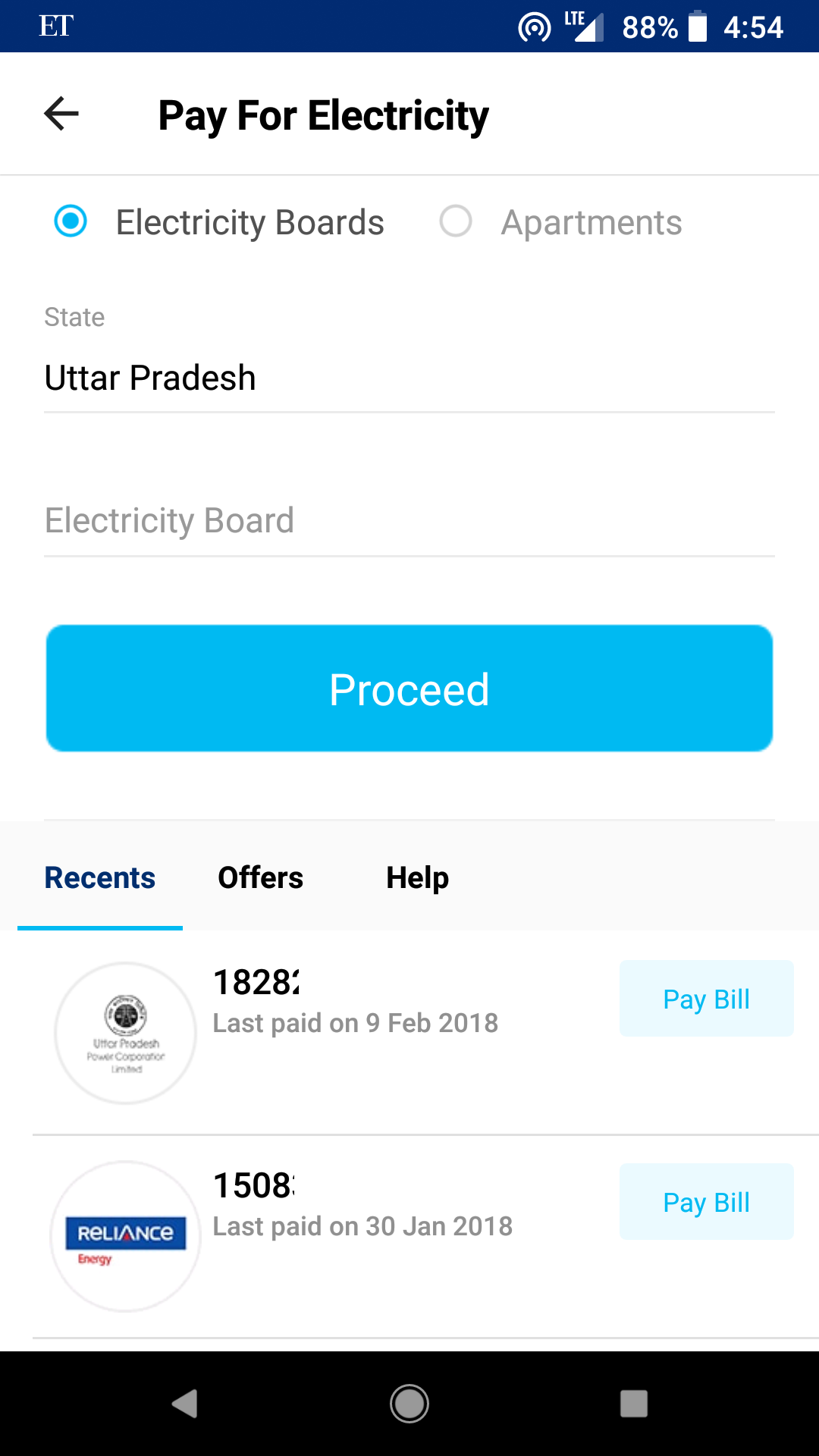
    Every month I end up paying some 5-6 different mobile/landline and a couple of DTH bills.

    A few years back I started paying the Airtel bills online – the process was easy and it was the same interface for all Airtel Payments – mobile or landline.

    Just one drawback – there was no “Make another transaction” button.

    One had to go back to home page, and start the flow again. I shared this with my friends at Airtel Money and quite a coincidence that this button was added on their web page (they confirmed that my raising it with them had nothing to do with the feature going live).

    Since then its been how I have paid all my Airtel bills.

    PayTm bill payment
    On the other hand, my experience with TATA Sky’s online payment was horrible to say the least.

    During one such failed attempt, I remembered about Paytm and decided to use it.

    And boy was it an amazingly designed service.

    • The UI was really neat and intuitive.
    • Credit Cards were masked and stored for easy subsequent payments. One just needs to repunch the CVV and the Verified by VISA passwords.
    • Old payments were stored and it was super easy to bring up an old payment and make a fresh one against the same DTH/mobile account.
    • In case of a failed payment to the service provider, the amount is kept in a Paytm virtual wallet that is “automatically”(this is true customer delight) picked up first during any subsequent payments and only the delta amount is required to be paid by the card.

    Needless to say my bill payments have migrated to Paytm .

    But not all.

    I suddenly realized that my de-facto reaction when making the Airtel payments was still to go to the Airtel website and not PayTm. This was strange because from a rational perspective I had no reason to not switch my Airtel payments also to PayTm.

    And this got me wondering.

    • I am not really loyal to the Airtel website, its just a question of habit I guess. Its not a strong habit to the extent that one can explain it through muscle memory. But the reality is that I followed the above steps without thinking much – picked up the bill, went to the Airtel site, paid and got it done with.
    • Is my behavior sticky with Airtel because they managed to get to me first and delivered a decent experience? If yes, then the first-mover-advantage for consumer services should be the possible stickiness-hurdle it creates for new entrants.
    • Has PayTm got me as a dedicated customer for their wallet services? Would I choose to pay at lets say Myntra (flipkart has its own wallet and Snapdeal is working on one) through a PayTm wallet? I am not too sure.
    • Although I am an avid Android user with a lot of apps that I use regularly but I still don’t have the PayTm app on my phone. Why? I am not sure. But I remember seeing their messages online and have seen their app in the Google Playstore also. Again no logic to explain this behavior. Wouldn’t the guy in charge of Data Analytics at PayTm be looking at my profile and thinking this guy probably doesn’t have a smartphone or a 3G connection.
    • Now that I have spent some time thinking about my strange behavior, would I go back to the Airtel site or migrate to PayTm? What do you think?

    UPDATE

    I have long since downloaded the PayTm app and it is now the default way to make ALL bill payments including the Airtel one(s). I no longer wait (or bother) for the bill to be delivered – PayTm manages my bill presentment and payment experience end to end.

  • Recommended feature for Google Maps Application

    Gratitude First – I am really thankful for Google for the traffic layer on its Maps application. Like most others in Delhi, I have become a regular Google Maps user now, checking the traffic updates and choosing the route that I should take to reach my destination. So much so, that my driver also insists on it.

    I started tracking my typical usage behavior and interesting things surfaced. I would open the application if:

    • I am going to a new/unusual place or
    • To the usual place at a not-the-usual time,
    • I don’t know the route or the traffic conditions or both
    • Faced with a traffic build-up on my usual route to work(or back) to see how long the jam was and what was the situation on alternate routes

    And amongst the situations listed above, almost 90% of my usage was due to the last one – traffic buildup ahead of me on my usual route to work or back home.

    Also, since my daily commute is almost 40kms one side, many a times there are multiple congestion points that I encounter. And some of those develop while I am on my way. Hence even if I check the traffic at point A and see that everything is clear downstream, chances are that the situation would change when I reach the downstream point B.It can be very frustrating, trust me.

    There’s another scenario that kicks in – given the resolution at which maps open up basis my current location, I need to scroll a lot to check out the whole path. Many a times I miss out checking the traffic congestion at far-off points.

    google-maps-traffic-layerAnd this set me thinking – wouldn’t it be a great feature for Google maps to

      • allow me to set my usual route for work/home
      • jump directly to my route showing the areas with traffic build-up or

    better still, alert me even without my opening the Google Maps app that there are places where there is slow traffic. This would have been true delight.If this is possible, can we build a web-app to send traffic updates to people who do not have a smartphone. Can such users register their routes and get SMS updates? Why not?

    As I toyed with the idea, I started wondering, why hasn’t Google done it already.

    This is a very simple and intuitive need, surely someone at Google would have articulated such a need long time back.

    So I started understanding how Google Maps work and what I discovered in a quick 2-3 hours of research was the following:

    • Google has a similar feature (time to destination – work or home) in its Google Now set of widgets. But its not really the kind of delight that I was referring to.
    • Google might not want to do it – Google collects and calculates traffic data from users who are using Google Maps and sending their locations to the Google servers. This means, Google would always need higher number of users to stay-on with their Maps/location services for them to get more data-points to have a better traffic estimate.
    • And maybe independent developers also cannot do it – The Traffic heat-maps are a “layer” on the Google maps and they are provided in a similar way in the API – a visual layer that sits on top of the geographical UI. This means that any developer would not get a feed of locations/latlons along with the traffic feed. To develop the kind of app/feature I referred above, the Google traffic API would not be helpful.

     Update:

    With today’s experience I think Google should still go ahead and build this feature. I now feel that this feature would kick-in more signins into Google Maps. Why?

    If I get an alert that there is traffic in my usual path and the alert doesnt mention the specific points, I would be tempted to login into Maps and see where the blockage is. What are the alternate routes and what is the situation there.

    One challenge here is that not every one might have their GPS on and it might be tough for Google to know if the person is already on the move or not. It could choose to send these alerts only to those with GPS on. This would serve two purposes – more people would keep GPS always on, hence provide the feed to Google’s server to better calculate traffic pattern. Also with the GPS on, Google would know when the user is on the move on the pre-defined specific route.

  • Prediction comes true – In-site search market heating up

    Not so long ago, I had written a blog post on why Bing should focus on in-site search as a way to fight Google’s stranglehold on the search space. While no one at Bing or Google heard me out on this, Techcrunch now reports on how this space is heating up. Two start-ups have already raised serious Series A capital and are focussed on just this one opportunity – Making the In-Site-search experience better.

    Bing GoogleWhile the start-ups and its investors can rest assured of acquisition offers coming their way, it is still surprising to see that Bing and other Google challengers haven’t exploited this opportunity so far.

    The Techcrunch article assumes that Google wouldnt want a great in-Site-search product as it would mean fewer hits on Google.com. While people at Google might buy this logic (I wouldn’t – better to cannibalize own product rather than let another player come in), but how can someone at Bing justify leaving this space? Beats me. Any ideas?

  • Are commission based channels low on trust

    In US car salesmen are amongst the least trusted professionals. On digging deeper one finds that they share these low rankings with advertising professionals, stockbrokers, insurance salesmen and surprisingly politicans too (Members of Congress, Senators and Governors). Have a look at the Gallup report summary below:

    Gallup Sruvey Trusted Professionals

    While there must be multiple reasons for people to trust certain professions and mis-trust few others, I am sure that the commission structure in a specific industry does lead to a low levels of trust.

    My guess is that if consumers know that the middleman involved in the transaction could be motivated by goals that clash with theirs, they try and look at each conversation from the point of no trust.

    Take for example, an online advertising agency which typically charges you 15% of what you spend on ad-networks. I remember, doing a detailed review with my agency and discovering that they were far away from optimization basis the Click-thrus and bid-rates. My first reaction was that this team is knowingly trying to jack-up the media spends and hence their cuts. It was some 3 hours later that I realized that they were not competent enough to make sense of the numbers and reports that the ad networks shared. Their intentions were ok !

    Cars, stocks and insurance policies are all complex products with multiple features and specifications. This means that there is no single correct recommendation for any given customer. 

    When the customer seeks the agent to play an advisory role (whether implicitly or explicitly) and the agent himself is paid the sales commissions, the mind starts playing scenarios. And in most of these scenarios, agent has either shortchanged or duped the customer.

     Look at the top spectrum of Gallup’s survey results. Doctors, Nurses, Engineers are all selling a service rather than a product. A doctor might give us any medicine but we feel its our symptoms/ailment that got cured. Doctor is not in the business of selling medicines but of curing.

    And here’s an opportunity for the Financial Services industry – can we find a way to be percieved as selling services rather than pushing products and eating commissions.

  • Mobile Payments Security – concerns, issues, threats, models and measures

    One of the biggest reason why cash has still reigned supreme for purchases is the percieved safety it brings. It limits the potential damage to the hard currency one is carrying in her wallet. For many late stage adopters of plastic payment systems, secuirty has been a concern. Same is happening right now for Mobile Payments.

    Why is security a concern in Mobile Payments?

    Any financial transaction involving out-flow of funds without over-the-counter transactions typically weighs heavily on consumer’s mind due to the risks involved. Mobile payments are no different.

    The security concerns are aggravated in case of mobile payments, because the ancillary infrastructure is something that the consumer uses for many other purposes. And in many instances the consumer has seen a part of this infrastructure break. E.g. consumers would have experienced first hand their mobile phones conking off, or heard of virus attacks which erased or corrupted the phone’s memory. In contrast for debit or credit cards, the consumers would have rarely heard or experienced wire-tapping or cloning first hand.

  • Why Financial Services Cos need Designers and fast !

    I just came back from depositing a cheque into a relative’s HDFC Bank account. I know, its a crime that I did not use the Online Money Transfer services, especially since I am a self proclaimed Digital guy working in the Financial Services sector.

    Anyways, I was filling in the deposit slip with details of the cheque and the beneficiary account details and suddenly there was this huge frustration in filling the same information twice.  HDFC Bank does not use a carbonated Deposit slip like Citibank India does. And it stuck me that once I have experienced the Citibank’s way of filling the information once, I refuse to be forced through the seemingly ill-designed process. I eventually did fill in the bank’s half of the deposit slip but just scribbled the bare essentials in my half of it.

    So it got me thinking, why is it that our banks and other Financial Services companies do not “design” with the customer-experience at the center. In today’s world when better designed products and services are beating-the-shit out of their established competitors, why are Banks and Insurance Firms so slow to react.

    The rise of well-designed products and services is not something which is purely outside of BFSI sector. Any payments industry person would tell you that Square is a serious threat to VISA and MasterCard in specific business segments. Square’s well designed product and application just removed a few major hurdles in the overall process.

    The Branch

    The branch is probably the single most important customer touchpoint.  You might argue otherwise that your call-center or the website gets more traffic and handles more transcations. But the reality is that its at your branch that a true face-to-face interaction happens and that too because the customer wanted it. The customer is so keen to do that transaction or resolve that query that she has taken the pains to walk to you.

    Have you been to a branch of a Public Sector bank? Chances are that the iron-grill was chained and you had to take care while entering the branch premise. Sounds familiar? What do you think a customer feels while entering such a premise? Is he in a mood to listen to someone telling him to buy an Insurance product or is he likely to just walk out of the branch as soon as his chosen transaction for the day is done?

    I recently went to a TCS powered Passport Seva Kendra (PSK) and boy did it feel like a whole different world. The premises were clean, air-conditioned, there was line and crowd control. A token system which ensured timely processing, a display announcing which desk you had to report to and the works. Compared to my first experience this was a complete contrast.

    While getting your branch to look like the Jabong ad  might be an easy task, what is needed is a design oriented approach towards all the aspects of the customer touch points. Do we expect the customer to wait on us, if yes, is there a waiting area. Are our clients senior citizens, if yes, what facilities do we have for them (say dedicated desks). Do we serve them just water or tea/coffee too? Is it a self-service kiosk or we have a kitchen hidden somewhere. This very simple question is something that many MNC companies have failed to understand in the Indian context. I have been to a few corporate reception areas, where there is no one to ask you for water, leave aside tea/coffee. If you serve Indian customers, you might have created a big wall right there. Its part of our culture and just because its a corporate set-up we cannot ignore it.

    Jabong-bank-ad

    Beyond the branch

    Opportunity to design better goes beyond just the branch or the physical world interactions. Here are a few others that are ripe for design-disruption:

    • Credit/Debit-Card chargeslips. I remember that a French company presented to us way back in 2004 about printing chargeslips with detachable coupons. In almost a decade the only variations one has seen is probably an ad on the reverse instead of the usual T&Cs. The key thing that any designer would probably do is ask why a customer is given a chrageslip in the first place. If this is to keep as a proof of transcation, then most of current thermal printers beat the whole purpose. The ink just fades away. Does the customer need it to file for expense claims and reimbursement? How does the customer store it? Does it stay in their wallets or does it go into some envelope or drawer. I don’t know the answers but I sure know that chargelsips in their current avatar just don’t cut it.
    • Websites. I remember reading the findings of a Kern report which states that almost all Life Insurance co’s websites had a poor overall user experience.

    “Most online insurance websites provided minimal details about the policy, mostly hidden in a PDF brochure, making it very difficult for the customers to find details. The customers had to spend time to search for information, which was distributed throughout the website, in the absence of any reasonable user flow.”

    • Even Mobile apps. A friend on my Facebook network posted this. Enough said.

    American Express App

  • 9 challenges in digitizing the sales force

    Very few of us embrace change.Most of us would try our best to avoid any change in the status quo. Especially if it drastically impacts the way we work.

    Hence any initiative to convert an offline banking/insurance sales channel into a digitally-enabled online one, is sure to face a lot of resistance from the existing teams and one must be prepared to weather these strong head-winds. While there is no single solution which you could adopt, but a deeper understanding of what causes this overall resistance, would help you understand what needs to be done in your specific instance.


    sales-channel-digitization
    Source:Contractlogix.com

    Here’s my list of 9 challenges you might face in digitizing the sales channels at your bank/insurance company

    1. Sales force was not kept in the loop. Implementation was just thrust on them one fine day. Time and again we see that the lack of confidence-building measures lead to a clear mistrust in the new system and its capabilities. As the CIO or project owner you should start engaging with the end-users early on. Talk to the sales managers, their executives and articulate the clear value-add this would bring to their lives. Tell them how this system would make them more productive and help them grow in their art. Keep them posted about the progress of the implementation. If possible try and incorporate their feedback in the design/feature specs of the chosen solution. This would create local evangelists for your project and make your implementation so much smoother.
    2. Fear within the sales team, due to the sudden transparency. One of the key reasons, most enterprises wish to move their sales teams onto a digital platform is to bring transparency in the sales engine. There is an accurate real-time understanding of the key business metrics and hence a realistic estimate of the business pipeline. While this might be great for the Head Office staff, this is a matter of great fear for the sales executives and junior sales managers. They know that such a system would mean that anyone can drill down deep into a specific case and verify the details. Or the fact that the country head can also track each person in the sales machinery. This can be really intimidating for a junior sales resource. Imagine a magician’s trick being laid threadbare by a scientist – surely the magician would feel kind of naked. The way to address this fear is to ensure that the senior management refrains from micro-managing the sales team in the early days of the implementation. They should control the urge to dig-out a specific case, jump all hierarchies and talk directly to the sales manager. If your organization is not already used to a hands-on approach by the senior management, such jumping-of-hierarchies would spell disaster.
    3. Information Overkill. One of the advantages of any digital solution is the fact that it can store a whole wealth of data on the prospect, customer, channel and hopefully churn out beautiful reports in the process. If one gets carried away with such beautiful-reports-promise, the system might tend towards an information overkill.And the sales staff would be wasting time collecting “un-necessary” information when they should be out there talking to your prospects. Hence try and look at the system implementation as a phased journey. Get the basic feature spec out, build traction and revisit for further enhancements. It might be a good idea to read the MVP (Minimum Viable Product) approach now being promoted by most Silicon Valley Start-ups.
    4.  Non-existent or inefficient mobile interface. This is really relevant for enterprises where the sales happen face-to-face rather than on the phone etc. If your sales team is expected to be out in the field, your solution should go along with them. Many enterprises fail to imagine and develop a mobile solution and then focus on work-arounds. There are companies that expect their sales teams to call up a central number after each visit and update the details. In some others, the agent first notes the feedback on paper and is then expected to come to an e-enabled site (branch or café) and update the system online. In today’s world with such a high smartphone and 3G penetration, a mobile-first-interface would show a clear value to the sales teams.
    5.  Cluttered Design or too many screens. Unlike the glamorous world of consumer solutions, enterprise solutions have not been blessed with the talent of awesome designers. I personally feel this is a big big drawback because end of the day, the enterprise solution user is the same person. He would react the same way to a better design. If he has a great intuitive interface on his Gmail, Dropbox and Facebook, why not on his Leads Management System (LMS).
    6. Complicated Incentives. Increased transparency of the sales engine, suddenly throws up a bunch of metrics that the business managers love to track. While the incentives are simple to calculate and manage in the offline world, a LMS implementation usually comes with a highly complicated incentive plan. Most sales agents fail to have confidence in a new incentive system if there is no baseline. DO NOT coincide your system go-live with an incentive model change. Better idea would be to track the metrics for a while, show the agents how they are anyways performing on these metrics and then gradually build these metrics into the incentive system. Such an approach would mean that the sales team can “calculate” their possible incentives on Day 0 and be motivated to stretch their performance.
    7. Lack of helpful features. This usually stems from the lack of an agent-centric design (which is discussed separately in pt 8). Build features that really help them sell better, help them save time (e.g. tablet based insurance quotes means zero error in policy submission and hence no rework).
    8. Lack of agent-centric design. Enterprise solutions usually fail to deliver on their promises because of their inherent design (or architecture). Many an enterprise CRM solutions are not designed with the customer at the center. Similarly if our sales systems are not designed by keeping the agent at the core, it surely would see a lot of resistance and would fail to deliver. A good design where agents were involved from a very early stage, would take care of most of the issues mentioned above.
    9. System Roll-out plan
      • Lack of training before and during roll-out. Even if you are working under serious budget constraints, find a way to train the end-users. Build a knowledge repository, run a small help-desk for them to call/reach for any immediate help.
      • Find and promote early adopters. Even better find evangelists who carry a collective sense of ownership in the system and its promise. This needs to be done at all levels. I remember when I was rolling a LMS for the bank that I was working for, I had to convince the business head about the need for such a solution. All the usual advantages of a scientific way to run the sales channel couldn’t cut any ice. I had to finally show him the maths around system’s ability to uniquely pull-out non-contactable cases from his tele-calling units and hence a smaller base to work on for subsequent months. This simple feature was powerful enough (with enough cost savings on back of lower manpower requirement) for him to get excited and seek his business as the first one to cut-over.
      • Version 2.0. Do you hear what your users are saying? Are you evaluating the impact for the new features or changes they are asking? How soon can you give them a version 2? Its not so much about the number of days they end up using the version 1. It’s more about how soon, they start believing that this is their system and the company hears what they have to say.
      • Study how your users are actually using the system. Try and shadow some of the end users to see if they come up with their own work-around, own ways of using a feature for something that it wasn’t really meant for. What are they not using at all. Why? This is usually a great surprise and teaches most system designers a whole lot of stuff they had never imagined or seen before. Try and document these observations. Analyze and see if they can help you in a more acceptable version 2.0.

    In summary, some level of resistance is inevitable once you decide to digitize your sales team. But how you design your solution, how you engage with the end-users and how the enterprise uses in the early days, can decide if this will be a success or not.

  • The curious case of single order and multiple delivery consignments @ Flipkart

    This just happened to me again in a short span of time. I ordered 4/5 books from Flipkart and the ordered was split into multiple consignments and the two consignments were delivered within one day of each other.

    Initially I thought this was because the books might have been shipped from different warehouses or even merchant-locations. And maybe the second consignment’s availability and delivery- date wasn’t estimated before the first gets shipped out. But then again, both were delivered within 24 hrs of each other.

    Flipkart Deliveries

    Interestingly, since Flipkart does its own delivery, the same guy comes to deliver all Flikpart stuff at my place. He knows me pretty well by now and I asked him if why the same order was being split into multiple consignments. Even he was finding it funny that he delivers two days in a row to my house. He only knew that he has a certain area allocated to him and all his delivery packets come from one holding warehouse in NCR.

    Maybe thats where this is coming from. That Flipkart has a beat allocated to each guy, and the delivery guy has to work that beat each day. Hence it doesnt make much of a difference in splitting the delivery into two parts – he would be around in the neighborhood anyways.

    Also, I figured out that many of these deliveries were COD and maybe this was a way to put a cap on how much cash the delivery guy handles. Or maybe the risk of not shipping a big consignment to someone who turns it away or acts funny.

    But I still feel, they might find an opporutnity to further trim down their logistics cost and maybe even enhance the customer experience if they could find a way to re-aggregate consignments at the last-mile. Or will that put pressure on the mini-warehouse ? What do you think?

  • HDFC Life’s Campaign to protect you from the rains

    A colleague recounted an amazing experience she had at the Delhi Airport a few days back. She had just flown in and was waiting for her car.

    There is this small stretch at the Delhi airport that you need to cross from the covered porch of the terminal, to the waiting-car-lanes.  While the stretch is small, its easy to get soaked if its raining.

    There were young boys holding huge family-umbrellas trying to help people save themselves from the rains. The umbrellas were branded with HDFC Life logos and these enthusiastic boys were helping passengers reach their cabs/cars without getting drenched. And while they walked with you to your waiting car, they would very politely hand over a small HDFC Life card (images attached) which promotes their Click2Protect – Online Term Plans.

    Click2Protect

    I was so impressed by the way HDFC Life managed this.Could see so many reasons for them to be proud about this campaign:

    1. Its a very relevant offline activity. Most of us do not carry umbrellas and do get drenched a little bit if its raining.
    2. Insurance industry has been using the umbrella to highlight protection for years now. I can remember seeing way too many things under that umbrella – from house to family. But finally someone has made a meaningful and relevant use of the most recognized prop of the Insurance Sector.
    3. There is no hard-sell and the card is actually very humble in its tone and starts the conversation very meaningfully

      Thank You for letting us protect you

    4. Its probably one of the best Offline-to-Online campaigns that I have seen so far. They have chosen a simple product category to share – Term Plans. A product category that has been witnessing the biggest rush for customer-initiated-online-purchases.
  • Who owns the customer experience

    I have been a regular and very loyal customer of Flipkart. They have a neat UI, collection is great, prices are good and they manage deliveries very well.

    Chariots of the GodsWhile shopping for books last week I was shown a recommendation for “The Chariots of the Gods” a book whose introduction/teaser looked exciting. Needless to say I added it to my shopping cart (proof that recommendation engines are maturing fast).

    I got my consignment of books right on time, neatly packed with bookmarks etc. I finished the first book and then it happened. When I opened this book – The Chariots of the Gods- the print quality was shocking. It was so bad that it would have made the pirated road-side versions look like hard-bound editions :-).

    I tried reading the book a couple of times but just couldn’t get beyond the first few pages. So I wrote to Flipkart. I told them my angst and they promptly agreed to replace the book. I reminded them that they should do so only if the print quality was different from what I had got. So I got my revised copy and it was the exact same quality (or lack of it). Guess its just a badly printed book. Can’t really blame Flipkart ! Or can I?

    I guess as the leader in its space, Flipkart is viewed as the entity that promises to deliver a superior customer experience. Though their customer service was prompt and empowered to quickly respond to my case, they failed to investigate if they could really solve my problem.

    Also the promise of a good online experience also includes a guarantee that sub-standard products would not be stocked. The book might be awesome, but if the print quality is bad, someone at Flipkart should decide against stocking it.

    And I feel this is amongst other factors would determine which of the two models – marketplace vs inventory-driven models would emerge. Would marketplace managers be able to deliver a better experience, esp in categories where the product quality can vary?

    I for one would bet my money on those who know how to control and deliver a great experience, marketplace or otherwise.