Very simplistically put, payment is the movement of money from A to B.
And the world is becoming increasingly comfortable with money flow going digital. Whether its a consumer paying another consumer (P2P) or consumer paying a merchant (P2M) or business paying its vendors/suppliers (B2B) – the levels of digitization of these use-cases is very impressive.
But, what happens when the speed of digital adoption is very different at point A vs point B.
What does that mean for the digitization opportunities, challenges and product related nuances for the send and the receive side.
Let’s take domestic remittances as an example. In most of S Asia be it India, Bangladesh, Nepal – many blue collared workers send their monthly wages/salaries back home to their families/dependents.
These blue-collared workers are typically operating in urban or semi-urban areas and hence are exposed to an inherently more digitally savvy ecosystem. These workers have access to affordable smartphones, low cost reliable data-connectivity and also have multiple opportunities for assisted-on-boarding for any digital solution. Think of 4-5 workers staying in a house and one young digitally savvy showing others how to use the smartphone for voice or video chatting.
Their families (the receive side of this payment flow) on the other hand, may not have a similar eco-system. The data connectivity may be poor, opportunities for learning from others may not exist etc etc.
It might be safe to assume, that the digital adoption by the send side is expected to be much faster than the receive side.
And if that really happens, what does it mean?
Historically, domestic remittances was an agent assisted business. Remittance providers had extensive agent networks for cash-in and cash-out. Because the old flow has been :
- Worker gets the salary (most probably in cash)
- Goes to the remittance point (an agent outlet)
- Shares details of the recipient, validates himself and pays the amount (in cash)
- The recipient gets notified (usually on SMS) and
- Goes to a nearest cash-out-point for withdrawing cash. Or if it was a transfer to her bank account, would go to an ATM/branch for cash withdrawal.
Let’s look at what all is changing:
- Many workers will start getting salaries into accounts/wallets/prepaid cards
- Workers are digitally savvy now, comfortable doing transactions on mobile.
- Some may start using their mobile wallets, cards for merchant payments – because in their locations (urban mostly) there are merchants accepting digital payments.
- Many will not want to stand in line or physically visit an outlet to send money.
And this will mean that many mobile-originated un-assisted remittance origination services will flourish. All vying for this big base of consumers who are just becoming digitally savvy, just becoming comfortable enough to send their hard earned money digitally.
On the other hand, the receive side looks much the same as older times:
- Even if the family in the village gets money digitally, they cannot spend it digitally.
- ATMs may not be efficient for banks, so local shopkeepers are best way to withdraw cash.
- And since this shopkeeper has been the usual cash-out point, one may see little value in changing how the remitted money comes in
Again, to make things really simple, lets assume that there are two distinct profiles on either side.
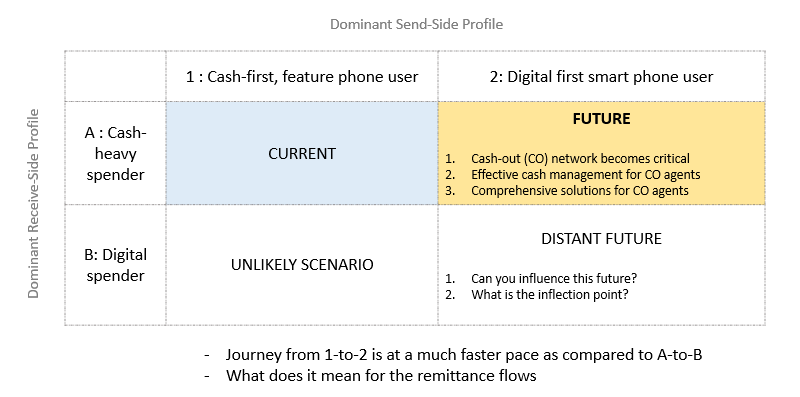
- Send side – 1. Cash-first, feature phone user and 2. Digital first smart phone user
- Receive side – A. Cash heavy spender and B. Digital spender.
And let’s assume that digital adoption is process of migration from the first profile to latter of a large enough pool of consumers. This would give us the usual 2X2 matrix. Here’s a quick visual model of what all this means –

While this may be an oversimplified assessment, the bigger point I am making is the following:
- For most transactions (not just in payments) , its a human at either ends. These individuals may have different environments, motivations, behavior and hence
- The rate of digital adoption at both the ends may vary drastically
- And this opens up a world of interesting opportunities as the use-case undergoes a fundamental change – bottlenecks will shift, old assumptions fail, new business models will need to emerge
- And it in in these times that disruption works best. The incumbents may be too committed to the old model and the new players may have just timed it right.